Discipline
Conform, transform, and maintain social commitment: accept, adapt, and remain within norms.
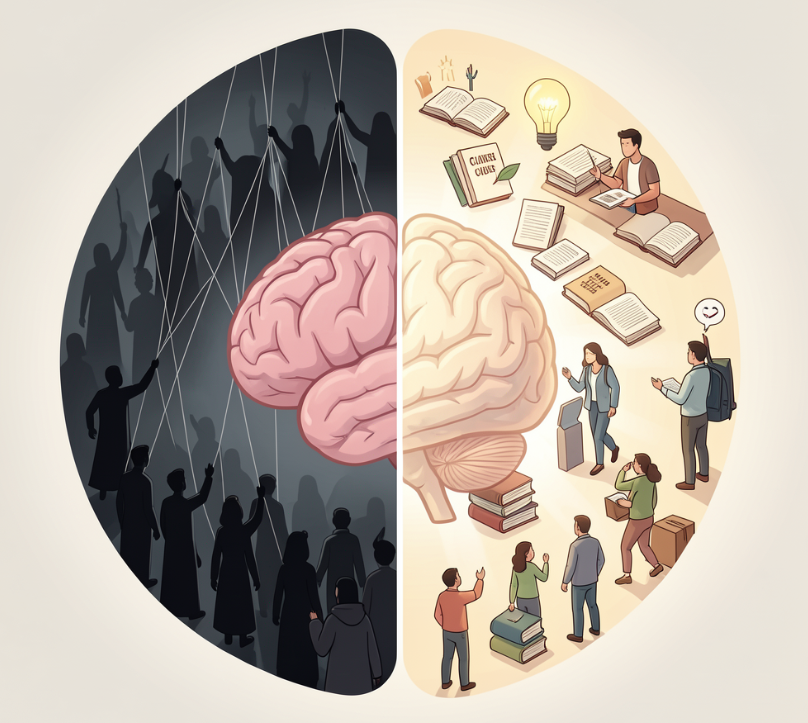
We do things in a certain way, often not the way we want, to reach what we desire. Of course, there are established ways of doing things, and whether we like them or not, we must adapt to a process that requires us to follow through on tasks we may not enjoy. Sometimes, however, these required tasks aren’t so unbearable; at times, we even find pleasure in them.
We procreate to stay, just like any other species; the difference is that we also have our culture that we want to pass on. The word discipline comes from the Latin discipulus (pupil) and disciplina (teaching) (Krishnan, 2009, p. 8). To be disciplined is to follow rules, instructions, or regulations to achieve a specific task or behavior.
Human Nature & Purpose
Purpose is the reason discipline exists: to serve the initial desire to live. This desire arises from human nature, our shared human capacities (Antrosio, 2011), and both the mind and the body are in continual transformation and evolvement. Roots tracing back to our ancestors run deep yet spread across the surface, resulting in diverse cultures and societies shaped by environmental properties. Discipline serves purpose; “disciplines here become scalable units that easily can be altered … for the purpose of creating classificatory structures” (Hammarfelt, 2018). In this way, structures maintain order as a form of control through discipline.
The purpose of a journey is the reason the journey exists. If my purpose is to build a tree house, I must decide and commit to firm, disciplined actions. This may make me feel more capable, but it may also challenge my perception of myself; this is where habits take hold. I train my mind to support myself, my body to complete complex tasks, and my behaviour to align with my expectations.
Sometimes, when discipline succeeds, creativity diminishes, as discipline can act like a fire extinguisher. Not all disciplines suit all people, and few disciplines suit few people. Here enters the meaning of purpose. Meaning asks, “what to live for?” while purpose asks, “how to live and who to become?” (Golushko, 2025).
Perhaps we have been shaped by control; perhaps human nature could have evolved differently, not as a dormant, centralised, controlled race, but as synchronised chaos rather than hidden agendas and superficial, fabricated desires. Perhaps human nature involves forgetting our own nature, chasing something dreamlike. No matter the scenario we imagine, one of love and peace where no war has ever happened, one of vampires and werewolves, one of magic powers and flying carpets, human nature seems to forget its true nature, because being human appears to involve conscious ignorance.
“Whatever our nature is does not exist before our growth within a specific environment, beginning with a maternal environment” (Jason, 2011). In other words, human nature is simultaneously created and developed through continuous conscious growth. The questions:
Who am I? (diagnosis)
Where am I? (orientation)
What and when to act? (strategy)
What is right? (morality)
are elements designed to understand the anthropology of purpose.
Anthropologists describe humans as having a universal capacity for culture, language, and symbols. The meaning of a subject or object appears as an act of reference (Radford, 2006), while the meaning of purpose appears as a personal and intimate value. Discipline traces back to ancient times, with its main purpose being the transmission of knowledge and the maintenance of order (Greyvenstein, 2022).
State Control
The purpose of the rules and regulations that countries impose through occupational choices, educational requirements, economic activities, and political influence is to establish social order. Rulers and authorities impose limitations on both objects and subjects while expanding ideological and practical forms of existence.
“There is a strong connection between discipline and power” (Pierre Bourdieu, 2003 [1984]). States have asserted social, biological, technological, economic, and political dominance through disciplined citizenship, conditioned soldiers, compliant students, trained workers, obedient housewives, and even domesticated animals. Foucault addresses this by highlighting not only aggressive forms of communication in the political realm, such as violence and brutality, but also subtler mechanisms of power exercised through schools and institutions. These mechanisms foster internalized judgment, leading individuals to regulate themselves in accordance with norms (Foucault, 1995 [1975]).
Richard Whitley describes academic disciplines as organized units of the working force, specialized in a particular form of knowledge that contributes to knowledge production. To be defined as a discipline, a field must be recognized as a distinct area of research (Whitley, 2000). Whether one belongs to a political party, enters a research department, joins a cult, or travels to a foreign country, one becomes subject to forms of discipline as such.
“Conformity is encouraged by disciplinary collegiality…” (Gibbons et.al., 2011[1994], p. 149); adaptation and compliance are reinforced through collective teaching. Disciplines can thus be understood as institutions oriented toward reproducing themselves, with a primary focus on training and instruction. The strong relationship between modernity and discipline explains how sovereign state power transitioned into disciplinary power that penetrates minds and souls (van Krieken, 1990). The enforcement of rules and regulations ultimately serves those in power, maintaining social order within the imbalances of modernity…
Cultural Aspect
“One can be aware that the ways one can have a self vary not only across cultures, but also across history; they change and develop over time” (van Krieken, 1990). Just as religion, politics, or medicine are social domains, morality should be treated in the same way, as a cultural system. Morality has a contradictory nature: it reproduces moral ideologies while simultaneously generating a need for moral freedom, which can ultimately lead to social change.
The purpose of morality is to distinguish between right and wrong. This raises the question: “Are categorical distinctions in binary forms, such as right/wrong, good/bad, holy/evil, virtue/vice, nurturance/negligence, and creation/destruction, experientially flexible, or are they static and culture-bound?” Anthropologists generally advance two perspectives on the moral compass: one emphasizes psychological and physiological concerns with suffering, while the other focuses on social order and religion (Csordas, 2013).
Social Discipline
Social discipline finds its way into our routines and mindsets.
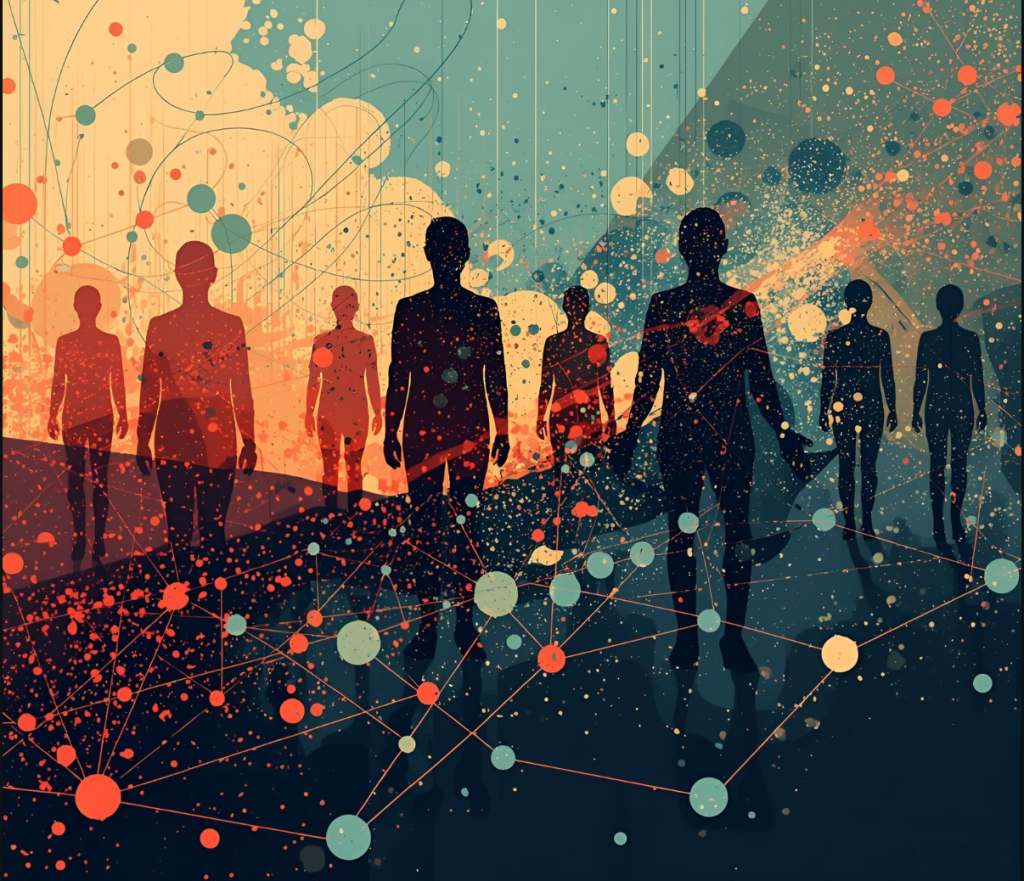
We are part of a web of human interaction shaped by moral and normative systems. Social discipline is a strategy of collectively agreeing on rules and expectations for certain behaviors and understanding them, leading to better conflict resolution, reduced disruption, and a more balanced collective atmosphere. Its trajectory involves managing behaviors that foster respect, responsibility, and support in a learning environment (Fiveable, 2024). Learning environments can also exist subtly in everyday life when individuals remain open to learning at work, the gym, art classes, museums, theatres, music spaces, and beyond.
The social discipline window is a model used in restorative practices to recover what seems lost and to cultivate compassionate, relational awareness. When disciplining or teaching, four approaches can be adopted:
– The neglectful approach: doing nothing; ignoring.
– The punitive approach: punishment for misbehavior.
– The permissive approach: doing things for others.
– The restorative approach: working together. (Sayers, 2020)
These approaches also apply inwardly. Do we not all experience denial? How often do we punish ourselves with guilt? Have we not avoided what we were capable of doing ourselves? Do we sometimes feel disconnected from ourselves?
Self-Discipline
Self-determination theory explains self-discipline as an individual’s conscious self-restraint to regulate behavior, speech, or adherence to rules without external supervision (Duckworth & Seligman, 2005). Self-control centers on regulating behaviors and choices, while self-discipline reflects consistency and restraint over time. Self-discipline supports tasks that require self-control and reduces procrastination. Individuals who lack self-control and struggle with self-regulation tend to procrastinate more.
According to this theory, three fundamental psychological needs exist: autonomy, competence, and relatedness. Self-discipline is a persistent choice rooted in personal will; this choice can cultivate strong willpower and courage, resulting in a sense of inner peace (Tao & Jing 2023). While self-discipline is often viewed as the most effective means of achieving goals, it is also a human construct that can create a perceived separation between nature and humanity. By this separation, I refer to the idea that fulfillment through purpose may reinforce feelings of incompleteness, emptiness, and conditioning.
Although self-discipline can help individuals reach a grounded state and a sense of internal freedom, this outcome depends on how freedom is defined. Increased self-discipline leads to the regularization and routinization of the psyche, drawing individuals into the external economy of bureaucracy, where social discipline produces rational domination (van Krieken, 1990)
Society Creates Discipline
The intersection of lateral and longitudinal perspectives reflects an image of natural tendencies and creative potential. Mother Nature creates us, and in turn, we create a lawful authority, a symbolic “father”. An irony with profound intelligence lies in the concept of discipline: the invention of a constraining system intended to guide human nature. Many complex concepts intersect here, including morality, the meaning of freedom, the purpose of success, the rationale behind purpose itself, the nature of power, and our metacognitive capacities.
References
Greyvenstein, J. (2025a, August 22). The history of discipline: Exploring its evolution across time. Grump to Great. https://www.grumptogreat.com/history-of-discipline/
Antrosio, J. 2011. “Anthropology and Human Nature: Human Beings in Process” Living Anthropologically website, https://www.livinganthropologically.com/biological-anthropology/human-nature/. First posted 2 July 2011. Last updated 16 June 2020.
Golushko, R. I. (2025). Anthropology of Purpose: Problem Statement and Research Perspective. https://doi.org/10.2139/ssrn.5453195
Radford, L. (2006). The anthropology of meaning. Educational Studies in Mathematics, 61(1–2), 39–65. https://doi.org/10.1007/s10649-006-7136-7
Krishnan, A. (2009). ‘What are academic disciplines’. University of Southampton, NCRM Working paper series 03/09. Retrieved from http://eprints.ncrm.ac.uk/783/1/what_are_academic_disciplines.pdf
Bourdieu, P. (2003) [1984]). Homo academicus. Translated by Peter Collier. Polity Press: Cambridge.
Foucault, M. (1995) [1975]). Discipline and punish: The birth of the prison. Translated by Alan Sheridan. Vintage Books: New York.
Hammarfelt, B. (2018, September 11). What is a discipline? the conceptualization of research areas and their operationalization in Bibliometric Research. STI 2018 Conference Proceedings. https://scholarlypublications.universiteitleiden.nl/handle/1887/2713957?solr_nav%5Bid%5D=87ef7a7b7fc2d8cabfb6&solr_nav%5Bpage%5D=0&solr_nav%5Boffset%5D=0
Gibbons, M., Limoges, C., Nowotny, H., Schwartzman, S., Scott, P., & Trow, M. (2001) [1994]. The new production of knowledge: The dynamics of science and research in contemporary societies. Sage: London.
van Krieken, R. (1990). Social discipline and state formation: Weber and Oestreich on the historical sociology of subjectivity. Amsterdam Sociological Journal, 17(1), 3–28. https://doi.org/https://ugp.rug.nl/ast/article/view/23462/20917
Csordas, T. J. (2013). Morality as a cultural system? Current Anthropology, 54(5), 523–546. https://doi.org/10.1086/672210
Fiveable. (2024, August 1). Social Discipline – Classroom Management. https://fiveable.me/key-terms/classroom-management/social-discipline
Sayers, L. (2020, September 22). The Social Discipline Model. Linda Sayers Restorative Practices Training & Consultancy. https://www.sayerstrainingservices.com/blog/the-social-discipline-model
Duckworth, A. L., & Seligman, M. E. P. (2005). Self-discipline outdoes IQ in
predicting academic performance of adolescents. Psychol. Sci. 16, 939–944. doi:
10.1111/j.1467-9280.2005.01641.x
Tao, S., & Jing, Y. (2023). More sense of self-discipline, less procrastination: The mediation of Autonomous Motivation. Frontiers in Psychology, 14. https://doi.org/10.3389/fpsyg.2023.1268614
Whitley, R. (2000). The intellectual and social organization of the sciences. Oxford: Oxford University Press.
Edited and copyedited under the supervision of Fatima Nazar