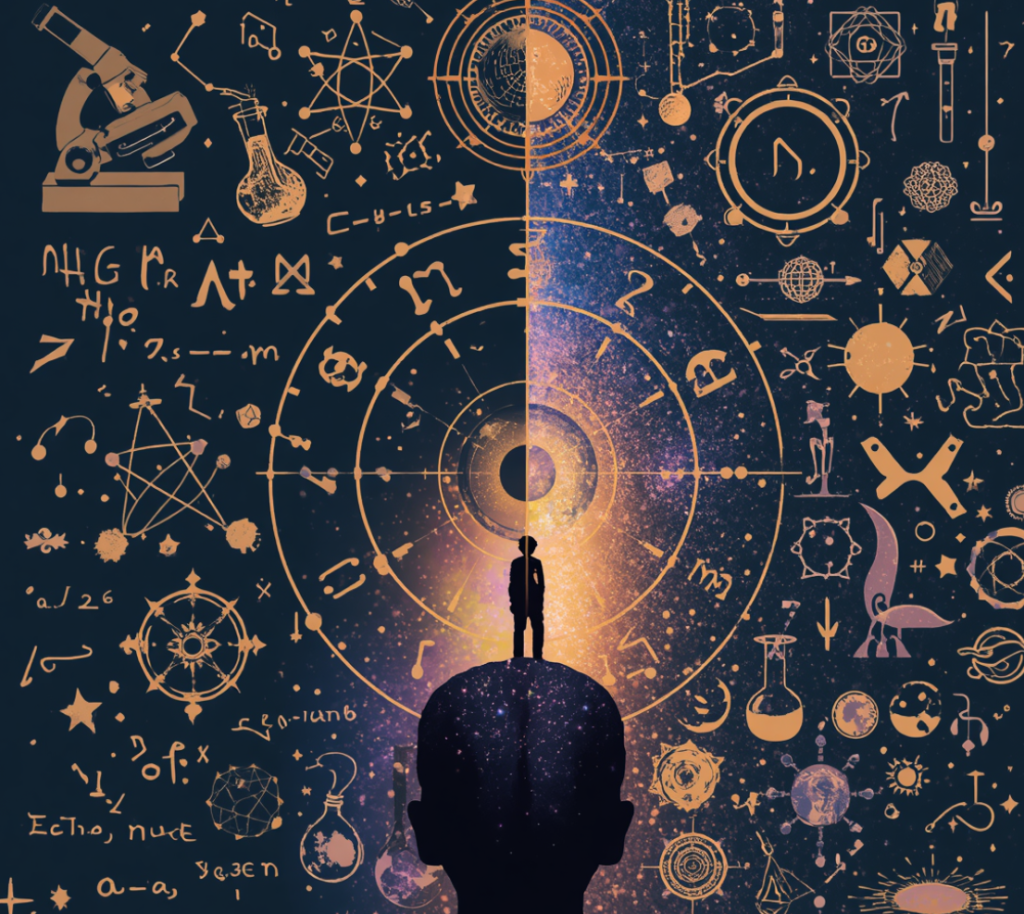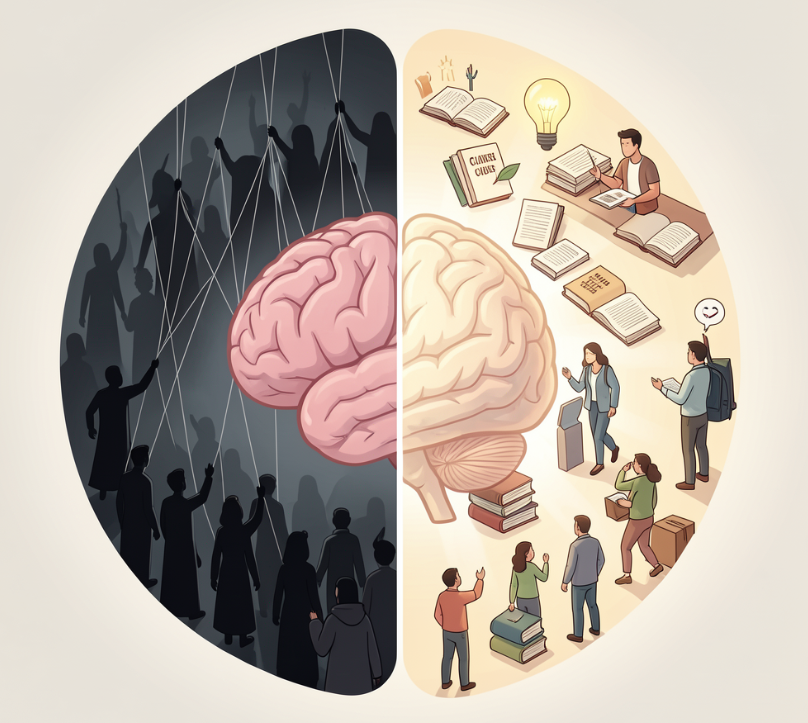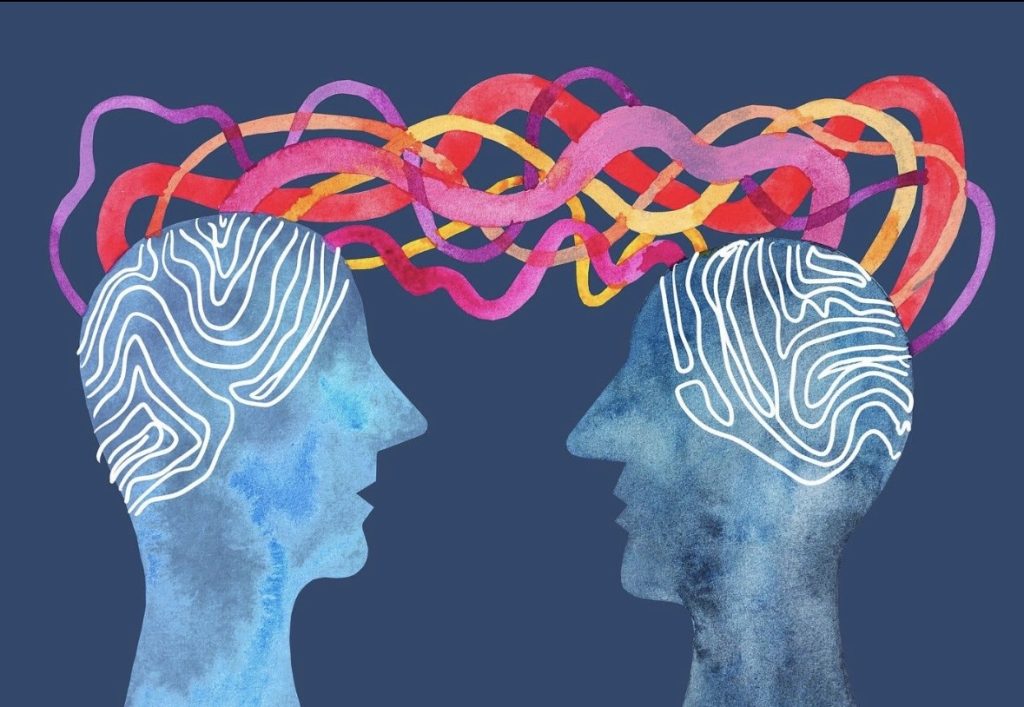
Telepathic abilities have always fascinated me; the question of whether it’s true, what they say, that someone can keep you awake simply because they’re thinking of you. I wanted to write about the possible influence of the evil eye, and about coincidences that we might take as signs. About inconveniences that we might perceive as unfair, and alterations or distortions that we might provoke in nature.
This led me to discover a concept called psionic abilities: an ExtraSensory Perception (ESP) that we humans have, also known as psychic ability. Thalbourne (2006) defines it as a general term identifying a sensorial potential that is none of the existing senses. He differentiates between ESP (telepathy, clairvoyance, or precognition) and psychokinesis (PK). PK refers to moving things without bodily methods, and ESP refers to obtaining of information without the use of physical senses. We are talking about moving objects (matter) with our minds, as in telekinesis, or receiving thoughts and sending messages through the mind, as in telepathy, and so forth. The term tele means “from a distance,” and pathy means “feeling” or “being affected by.”
Empathy, as we generally use the term, is the ability to understand someone and to feel with them. When speaking of tele-empathy, we could extend that understanding to mean something like being present in a place you are not physically in. For example: you’re driving, and the thought of a friend pops into your head; not a minute later, they call with news. Such things happen all the time, and we often don’t pay attention to them, or we dismiss them, because what is there, really, to look at?
Going deeper into the psionic phenomenon, I came across parapsychology, the branch devoted to studying unexplainable and unusual psychic events. Such studies carry a higher risk of error, because these phenomena cannot be proven on the physical plane through a pragmatic approach alone. It is harder for science to distinguish between chance and genuine ability, as in someone flipping a coin ten times and correctly predicting the outcome all ten times. Professor Winter sheds light on the intersubjectivity that exists throughout nature, in symbiotic systems such as mushrooms and the plants or trees they connect to. He describes intersubjectivity as common to all organisms: an actual connection, or feeling, rather than a mere interaction of acting and reacting. It is where experiences overlap. Discussing psi abilities, he refers to “a process that is shown to occur across biological, physical, and psychological domains” (Winter, 2022). By biological, he means animate, living organisms; by physical, things such as water, gas, or the speed of a car; and by psychological, thoughts and imagination. He offers dance as an example of an activity suited to creating an intersubjective state, one that involves rhythm (biological), movement (physical), and cultural context (psychological). Dancing is usually accompanied by music and chanting: art. No matter the civilization or the era, there has always been dancing. Intersubjectivity allows for the projection of oneself onto an object or a work of art; in another sense, it is also the ability to live within another’s state: telepathy. There are neurons called mirror neurons, which fire as though we ourselves were doing or sensing what we observe in someone else. In simple terms, they are responsible for an individual’s capacity to experience another person’s experience; empathy (Di Pellegrino et al., 1992). “Neural mirroring facilitates social behaviour by helping us to understand the minds of others, making intersubjectivity possible” (Holland, 2020). What is cognitive intersubjectivity? “The simultaneous non-verbal/non-gestural sharing of thoughts or mental processes among two or more individuals; in plain terms, telepathy” (Winter, 2022).
This is not simply a matter of consciousness in the brain; it is a whole energy dance between the body, brain, and world, and being able to remain conscious across such dimensions would be a remarkable skill. Parapsychology, the branch that addresses the topics mentioned above, also covers subjects such as astral projection, manifested intention, and near-death experience. The distinction in terminology is apparent but not fundamental: what anthropology calls magic, parapsychology calls psi (Luke, 2010). One report found that people living in tribal conditions tend to perform better in psi experiments (Elkin, 1944). But why?
Tylor wrote of “magic arts” in his book Primitive Culture (Tylor, 1873). Sciences that lack sufficient empirical support are labelled “occult sciences”. Historically, the “superior” race believed that magic and related practices belong to the “lower” race. They were seen as uneducated and placed at the most inferior stage on a hierarchy of civilisation: savages, from which most people supposedly progressed toward today’s “modern” civilisation. Modern science largely classed magic, sorcery, witchcraft, ESP, and PK as occult; superstitions confined to the “lesser” levels of society, or so history has told it. As technological and industrial development accelerated, this progress outpaced understanding, and a fear of the nonsensical emerged. Even within religion, this disregard was pronounced: “the basis of theological science must be historical as well as evidential”. Floridians, Malagasy peoples, the natives of Timor, the Tupinambá, and the Nuer are among the ethnic groups that were studied unfairly, met by anthropologists whose claimed to understand them masked real indifference. Their sacred sacrifices and beliefs in spirits, deities, and nature; their conceptions of good and evil were barely acknowledged. Any definition of spirituality or religion that differed from that of those in power was effectively treated as non-existent. Therefore, the spiritual or religious essence of the “lower” race was never granted the status of sacred knowledge; instead, it was cast as supernatural, unreal, and beneath that of non-tribal societies.
The study of myth has done the most to illuminate the processes of imagination shared by all humans. In every civilisation, mythical figures, otherworldly yet embedded in this world, recur across cultures. Myths speak of love and hate, of calamity and calm, of divine and powerful entities, of death and the elixir of life. Extraordinary powers that feel ordinary within the story make complete sense there, even as they remain, in the present and in reality, wholly unreal.
Humans share a common alphabet: symbolism. Behind every symbol lies meaning. The actualisation of imagination gave rise to myth, and most imagination springs from the same source: emotions, a shared search for meaning across many people, a question asked in the here and now. Myths extend beyond animate beings; spirits and aliveness are also attributed to inanimate objects such as the sun, the river, the moon, and rocks. This is animism.
Animism is the belief that everything possesses a spiritual core. Animism is considered the root of all magic; it is “the conception of the human soul [that] has remained from the first that of an animating, separable, surviving entity, the vehicle of individual personal existence”. An unfortunate bias has long surrounded the reality of magic: refusing to acknowledge its possibility also forecloses the search for empirical and evidential proof. Western and anthropological theory needed recalibration; Weiant and Margaret Mead were among those who championed the study of parapsychology and its implications for anthropology. Malinowski distinguishes psi magic, which he treats as spontaneous, from the magic part related to rituals, traditions, sacred acts that serve a society’s constitutional function and the maintenance of belief. He states that all magic is rooted in emotion (Malinowski, 1925).
The evil eye takes many forms. Telepathy happens unconsciously. Coincidences can be read as anything we want them to be. And inconveniences might simply be described as the absence of conveniences.
References
- Di Pellegrino, G., Fadiga, L., Fogassi, L., Gallese, V., & Rizzolatti, G. (1992). Understanding motor events: A neurophysiological study. Experimental Brain Research, 91(1), 176–180.
- Elkin, A. P. (1944). Aboriginal men of high degree. Australasian Publishing.
- Holland, J. (2020). Good chemistry: The science of connection, from soul to psychedelics. HarperCollins Publishers.
- Luke, D. (2010). Anthropology and parapsychology: Still hostile sisters in science? Time and Mind, 3(3), 245–265. https://doi.org/10.2752/175169610×12754030955850
- Malinowski, B. (1954). Magic, science, and religion. In Magic, science, and religion and other essays (pp. 17–92). Doubleday Anchor. (Original work published 1925)
- Thalbourne, M. (2006). Glossary. Journal of Parapsychology, 70(2), 417–421.
- Tylor, E. B. (1873). Primitive culture: Researches into the development of mythology, philosophy, religion, language, art and custom (Vol. 1). Gallica, Bibliothèque Nationale de France. http://gallica.bnf.fr/ark:/12148/bpt6k61535g
- Winter, W. (2022). Telepathy as a natural and normal process of life: Contextual support from biology, psychology, and philosophy. Journal of Consciousness Studies, 29(5), 130–149. https://doi.org/10.53765/20512201.29.5.130
Edited and copyedited under the supervision of Fatima Nazar